



Knowing the difference between an FCE and IME helps you request the right assessment the first time and avoid the cost and delay of ordering the wrong one.
If you manage disability claims, you have requested both IMEs and FCEs. You may not have had a clear answer to a question that comes up often: when does a file actually need a Functional Capacity Evaluation rather than an Independent Medical Examination, and what does it tell you that an IME can't?
The two are complementary, not interchangeable. Knowing the difference helps you request the right assessment the first time and avoid the cost and delay of ordering the wrong one.
What an IME answers
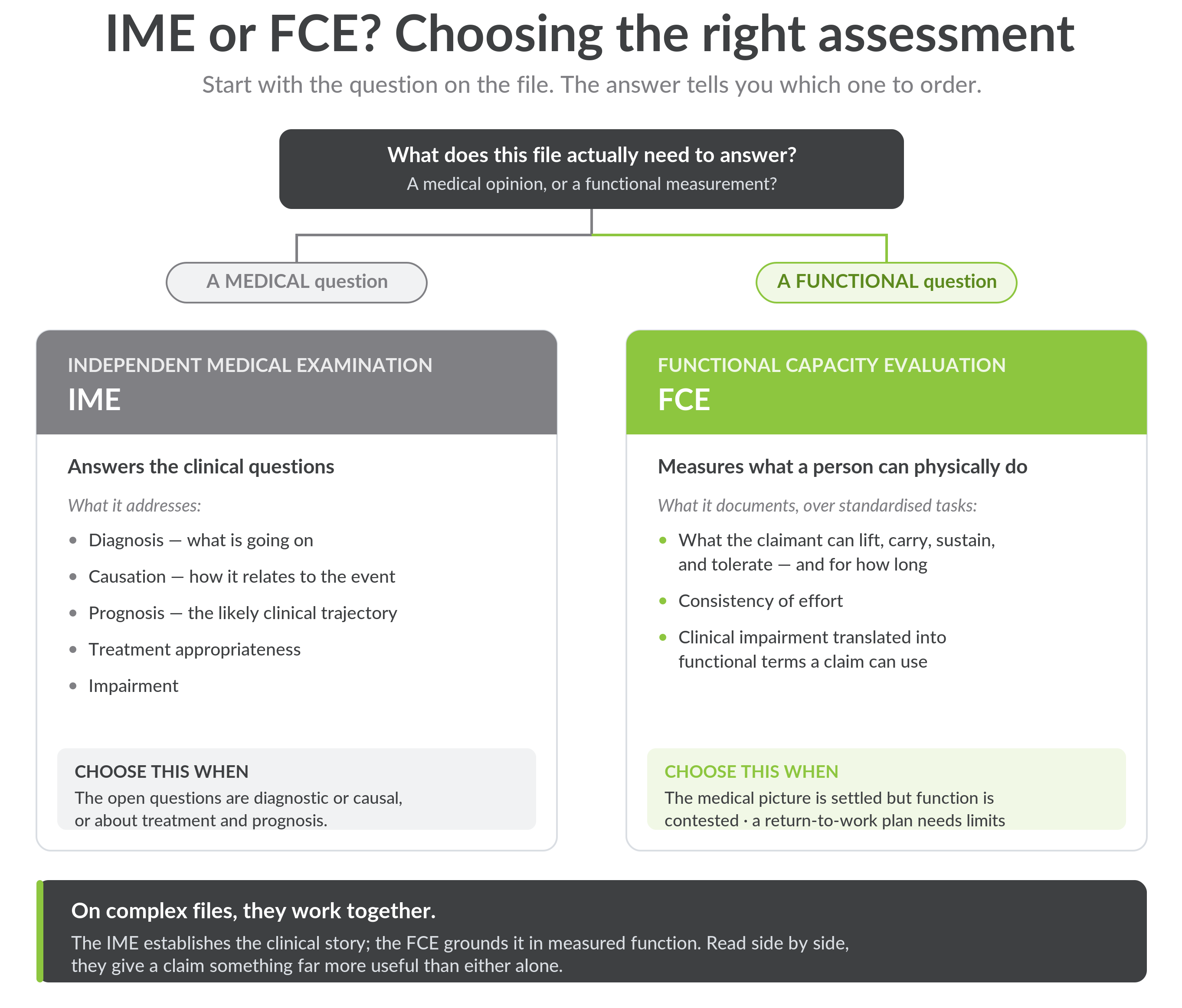
An Independent Medical Examination is a clinical evaluation. It addresses diagnosis, causation, prognosis, treatment appropriateness, and impairment. It answers the medical questions on a file: what is going on, how it relates to the event in question, and what the clinical trajectory looks like.
What an IME does not do is measure, in a sustained and objective way, what a person can physically do across a working day.
What an FCE answers
A Functional Capacity Evaluation is a structured, measured assessment of physical ability. Over a series of standardized tasks, it documents what an individual can lift, carry, sustain, and tolerate, and for how long. It looks at consistency of effort, and it translates clinical impairment into functional terms a claim can actually use.
The distinction matters most when the question on the file is not what's wrong, but what can this person sustain at work. A diagnosis tells you the condition. An FCE tells you the capacity.
When to reach for which
An IME is usually the right call when the open questions are diagnostic, causal, or about treatment and prognosis. An FCE comes into its own when:
- The medical picture is settled but the functional picture is contested.
- A return-to-work plan needs objective limits rather than estimates.
- Reported limitations and documented diagnosis don't clearly line up.
- A file is heading toward resolution and needs defensible functional evidence.
On complex files, the two work together. The IME establishes the clinical story; the FCE grounds it in measured function. Read side by side, they give a claim something far more useful than either alone.
Getting the request right
The most useful assessments start with the right question. If you can articulate whether you need a medical opinion or a functional measurement, you will get a report that answers what you actually need to know, rather than one that sends you back for a second assessment.
Not sure which assessment your file needs? The IMA Solutions team is happy to help you scope the right one before you refer. Get in touch.